Class 2 · Simchas Torah 5787
The Souvenirs We Don’t Choose
Faith through pain, gratitude for every breath, and the strength we give one another.
Watch or read the class ↗Open the class PDF ↗
Special class · 3 · 5787
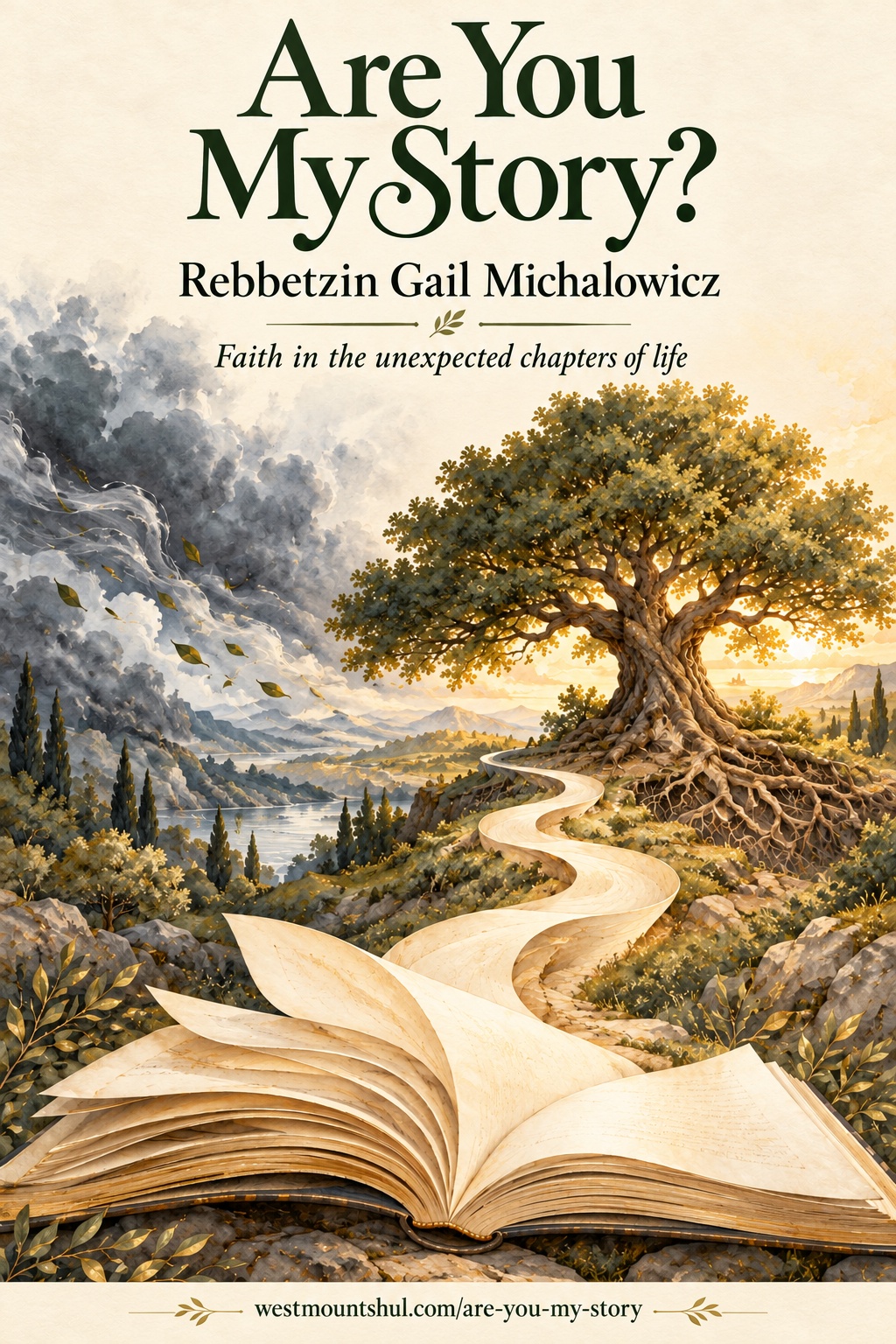
Rebbetzin Gail Michalowicz
Faith in the unexpected chapters of life. Finding Hashem’s closeness, the value of each small step, and the strength of our deepest roots.
See archived classes ↓The full class · 20 minutes
Rebbetzin Gail Michalowicz · Are You My Story?
An illustrated, 11-page transcript of the spoken class, lightly edited for readability, with “The Oak Tree” on the final page.
Continue learning
Class 2 · Simchas Torah 5787
Faith through pain, gratitude for every breath, and the strength we give one another.
Watch or read the class ↗Open the class PDF ↗Class 1 · Rosh Hashanah 5787
Imperfection, gratitude and Hashem’s loving call.
Watch or read the class ↗Open the class PDF ↗Transcript of the spoken class
Lightly edited from the recording, with headings added. The poem is placed at the end, after the Rebbetzin’s closing reflections.
There’s a classic children’s picture book written and illustrated by P. D. Eastman and edited by Dr. Seuss, entitled Are You My Mother? It’s one of my favourite storybooks. I loved reading it with my kids.
What’s the story about? It’s about a newborn baby bird that unfortunately falls out of the nest and begins a journey trying to find its mother. He meets all these different animals, a cow and a hen, and he keeps asking, “Are you my mother?”
In our lives, we can sometimes feel like we just fell out of our nest: our place of comfort and safety and our familiar story. We find ourselves in a new reality, wondering what just happened, asking ourselves, “Ah, this can’t be our story.”
We look up in bewilderment and ask about our new reality, “Are you my story? You don’t look like you can be.”
Most of us have some picture of how our lives will look long before we even put it into words. It’s the story of what our lives are supposed to look like, or what we’ve become accustomed to.
You start thinking about who you’re going to marry, what kind of family you’re going to have, where you’re going to work, your career, and so many other plans. You think, “If it doesn’t work out, it’ll be okay, because I’m in control and I’ll figure something out. My body’s going to cooperate with me. Everything around me is going to be okay. My future will resemble the future I’ve been imagining.”
And then something happens. You fall out of the nest. You fall from the life that you dreamed of, or from the life that you became accustomed to.
How does it happen? Sometimes it’s a telephone call that changes things. Sometimes it’s a conversation across a desk. Sometimes it’s a person leaving, a door closing, a loss we never anticipated. Sometimes it’s quieter: one year becomes five years, and the thing that we’ve been waiting for still hasn’t happened.
You wonder, “How are we expected to live in our new and unexpected story?” It seems unfair.
Here’s an idea that I’ve heard from a lot of rabbis, great rabbis: Rabbi Brog, Rabbi Miller of blessed memory. Perhaps you’ve heard it too.
Before our neshamah comes into this world, there’s an acceptance of the life it will live, in the body that it’s given, under the Divinely ordained circumstances.
In other words, your soul knows your entire story: all the parts, the good, the bad and the ugly, and even when you will fall out of that nest. Your entire story and its personalized mission. And it says, “I take it. It’s my story.”
Let us look at the source. Where do these rabbis come up with saying this? It says in the Talmud, in Rosh Hashanah, that Rabbi Yehoshua ben Levi says the works of creation were created “leda’atan,” with their knowledge, meaning they understood.
All the works of creation: the elephant understood what the elephant was going to be; the tree understood what the tree was going to be; and man and his story understood it too. Rashi explains that they were asked whether they wished to be created, and they said yes.
Rabbeinu Bachya, in his commentary on Devarim, takes this even further. He writes that created beings were informed at the beginning of creation of their circumstances and of the events that would happen to them. He includes their lifespan and their livelihood. And then he says, “Vehakol ratzu vekiblu”: all desired and accepted.
According to this teaching of Rabbeinu Bachya, there was an acceptance of all the circumstances and events that would happen to each of us by our souls before they came to their mission on earth.
Our souls understood what was going to happen. Our souls understood that this story was a Divinely designed destiny, and our souls appreciated that these stories fit us exactly as they were supposed to.
Now the question is: why would a soul want to come to a place where there is uncertainty and disappointment and vulnerability and loss, and be willing to accept that mission?
Why, says the Ramchal? Because the neshamah understands what the purpose of life is in this world. And what is it? To achieve the greatest pleasure there is. What God wanted to give us: the greatest pleasure. And what is that? The deepest, greatest good is closeness to Hashem.
That is achieved in this world through the work of your free-will choices. The world offers opportunities for closeness to Hashem through your personal story, through the pleasures in your story and through the difficulties in your story.
Think about it. A wedding can be a time of gratitude to Hashem and those around you, or it can be a time of petty disappointments. It’s your choice.
You go to the wedding and hear someone say, “I can’t believe this! The whole wedding is ruined. The flowers are the wrong colour. I ordered red, and look at this: they delivered yellow!”
Financial stability makes room for tzedakah, imitating the ways of Hashem. Or it can be a time for self-centred indulgence. Again, it’s your choice. Through those choices, you are either coming closer to Hashem or moving away from Hashem, either coming closer to this incredible pleasure or moving away.
A nisayon, a test or challenge, can create the opportunity for an inward capacity or potential to become action. Your challenge can bring forth acts of patience, empathy and bitachon, trust in Hashem, or frustration, anger and disappointment.
I had a crazy story happen. I had to take an MRI. You’re used to going in: it’s supposed to be at four o’clock; it’s supposed to take twenty minutes, whatever the case may be.
I go in for the MRI, and this wasn’t such an easy MRI because it was an MRI on the chest. You weren’t lying on your back. You’re lying on your tummy with your knees bent and your head bent down, and it takes quite a bit of time to get you perfectly lined up.
Once you’re inside this MRI, the technician tells you things like, “Don’t move,” and, “Don’t take deep breaths.” And that means you want to move and you want to take a deep breath!
I’m in this MRI and I start thinking to myself, “I’m going to be in here for at least twenty minutes. I can’t move. I can’t take deep breaths. What can I do?”
I start singing and humming this song in my head: “Baruch Hamakom, baruch Hu. Baruch shenasan Torah le’amo Yisrael.” That song is like, “Blessed is Hashem, and blessed is the place.” We’re actually referring to Hashem with the name Makom.
I’m singing, “La, la, la, la,” and there are always these noises in that machine: bing, bong. Suddenly I hear “shh,” and she opens up the MRI. I’m like, “What?”
Then the technician comes over and tells me, “I’m so sorry, but the scanner’s not working. Let me just do this all over again. Hop off, and then you’ll get back on, and we’ll fix this whole thing.”
I’m like, “Okay, never had this happen before.”
Second time, I’m on the machine. She’s got me all placed. It takes time. She covers it up. I go back to “Baruch Hamakom, baruch Hu.” Then I hear “shh.” She opens it up again and tells me, “I’m so sorry. I just can’t get this thing to work.”
She says, “Hop off again.” So I hop off again. She starts manoeuvring things, and then she tells me, “Why don’t you get back on?”
I said, “You know what? I just kind of think a machine like this, that costs so much money and is so sophisticated... I can’t believe that I keep having to go back on and off to test if this is working.”
I’m trying to really be patient. I’m trying really to control myself because this was really hard. It was bizarre. I didn’t know what to do, laugh or cry.
I looked up and said, “Look, there’s a message on the machine. It says a cable’s missing, and that’s why the scanner doesn’t work.”
She looks up and says, “You’re right. So why don’t you go to the waiting room until I really figure this out?” They call in a technician, and I’m sitting in the waiting room.
This MRI was scheduled for four, which was when we started the process. But I didn’t get back into the machine, until they fixed it, until five-thirty.
I was sitting for a really long time. More and more people were coming, and they were getting really aggravated. There were people who drove in from Ajax for this MRI.
It was a challenge. There was a lot that could happen: frustration, anger and disappointment, or patience, empathy and bitachon. It’s all your choice in your story.
The Mishnah says that one hour of teshuvah and good deeds in this world is more precious than all the life of the World to Come. It also says that one hour of serenity in the World to Come surpasses all the joy and serenity of life in this world.
There’s a profound distinction here. This world has the preciousness of doing and becoming. The World to Come has the preciousness of enjoying a spiritual good beyond what we now experience.
Our neshamah could accept the journey, could accept the story, because it understood the lasting value of what could be lived here in our story.
The Ramchal, in Derech Hashem, describes different people receiving different circumstances and different forms of avodah, of service to Hashem. Wealth and poverty can both bring challenges.
He also says that a person’s deeds are judged with exact regard to the burden actually given to that person. I think this is a very important thing. I’m going to say it one more time: a person’s deeds are judged with exact regard to the burden actually given to that person.
I think we have to realize this. Only Hashem can understand what that is for each of us. Only Hashem knows our true hearts and minds and environments and circumstances.
Therefore, for each and every one of us, if today I can only take one next step, that step belongs to my life, my connection, my mission and my choices.
There are days when it’s hard, when you just want to cry and you just want to wallow in your self-pity. I can’t understand your burden, and I can’t understand your strengths. I’ll never really know another person’s heart.
But each and every one of us has to understand that each step we take, each correction we try to make, each time we’re patient or empathetic or kind when it’s so hard, that step is eternal. We need to appreciate that. That step is the closeness and the pleasure that we’re really developing.
My worth does not depend on how impressive my coping skills look to others.
As we watch the pages turn and chapters end, it’s best for us to be very careful and take responsibility for one page at a time.
You know what’s so beautiful? We’re not alone. That’s what the good news is. We’re not alone in the creation of our story and the journey of our lives.
Dovid Hamelech tells us in Tehillim 91 that Hashem is with us in our distress. And Tehillim 23, very famous: even when I walk in the valley of death, You are with me.
I love this idea. The Chofetz Chaim tells us not a single detail is beyond the direction of Hashem. Every moment and every development is being guided by Him. Every page that’s turning, every new chapter, every piece of our story, even when we cannot possibly understand where it’s leading.
Where does the Chofetz Chaim come up with this idea? He says you find it in the beginning of the creation of the world, where it says the earth was chaotic and desolate and darkness covered the depths. Darkness and chaos everywhere. Sounds like if you listened to the news today.
Yet the very next words are, “Veruach Elokim merachefes al pnei hamayim.” With all this chaos, with all this darkness, the spirit of Hashem was hovering over the waters. In the midst of the darkness, Hashem was right there.
What appeared to be chaos was never outside of His control. Hashem was hovering over it, directing every detail and preparing what would come next.
And what came next? “Vayomer Elokim,” and Hashem said, “Yehi or.” Hashem said, “Let there be light,” and there was light.
Sometimes we may find ourselves individually and collectively as the Jewish nation in a situation that seems completely disorienting. What we need to remember is that “Veruach Elokim merachefes al pnei hamayim.” Hashem is right there.
Hashem has not left us. What looks like disorder may be the dawning of new light.
I read this beautiful idea from Rabbi Avigdor Miller, of blessed memory. The Talmud tells us, and I love this: when Moshiach comes and Eliyahu announces that he’s here, Eliyahu Hanavi will write a history. He’s going to write a Tanach, a collection of all of our personal stories, of every Jew.
The Gemara says, “Eliyahu kosev veHakadosh Baruch Hu chosem.” Eliyahu Hanavi is going to write it, and Hakadosh Baruch Hu will sign it. Hashem will sign it.
It will be the stories of all the so-called ordinary Jews, me and you, all of us, yet extraordinary Jews who chose to cleave to Hashem through their challenges and their blessings.
Continue to take your story, regardless of what chapter and page you’re on. Make the best of it and appreciate the eternal legacy that you are creating.
I just want to thank all of you. I’m closing a chapter, and may this chapter be closed forever. I just finished my chemo after four months, and I really have to thank Hashem. I have to thank all of you for your love, for your notes, for your thoughts and for all of your blessings.
As I’m going to be moving forward and opening new pages and chapters of treatment and surgery and recovery, I pray that, with Hashem’s help, I can make this the very best journey.
Today, it’s very interesting. When you finish your chemo, they have this bell in the chemo clinic and you get to ring the bell, like, “Hooray, this is all done!” I got my chance to ring the bell, and then they gave me a certificate, which was very cute. It was rolled up with a piece of ribbon.
When I got home, I opened it up. I’m going to read to you what the certificate said. It was a poem about a tree. It’s called “The Oak Tree.”
This is the Jewish people. This is us. We have deep roots, all the way from the Avos, all the way from our ancestors, from our grandparents, from all the strength that they had to go through their different challenges.
We sometimes don’t know what we can endure. Then the challenge comes, and Hashem says, “Just watch. I know this story, and even your soul knows this story. Trust Me.” Look what you learn: how strong you can be and how much you can grow.
Hashem Yisbarach, may God Almighty not challenge us with negative things. He can challenge us with blessing. May we have the chochmah, may we have the wisdom, to know how to use all these chapters and pages in our lives wisely, to really become the best person we can be, to really learn to cleave to Hashem and appreciate the wonderful life that we have.
Everyone take care, and all I can say is thank you so, so much.
A mighty wind blew night and day. It stole the oak tree’s leaves away, Then snapped its boughs and pulled its bark Until the oak was tired and stark. But still the oak tree held its ground While other trees fell all around. The weary wind gave up and spoke, “How can you still be standing, Oak?” The oak tree said, “I knew that you Can break each branch of mine in two, Carry every leaf away, Shake my limbs, and make me sway. But I have roots stretched in the earth, Growing stronger since my birth. You’ll never touch them, for you see, They are the deepest part of me. Until today, I wasn’t sure Of just how much I could endure. But now I’ve found, with thanks to you, I’m stronger than I ever knew.”